
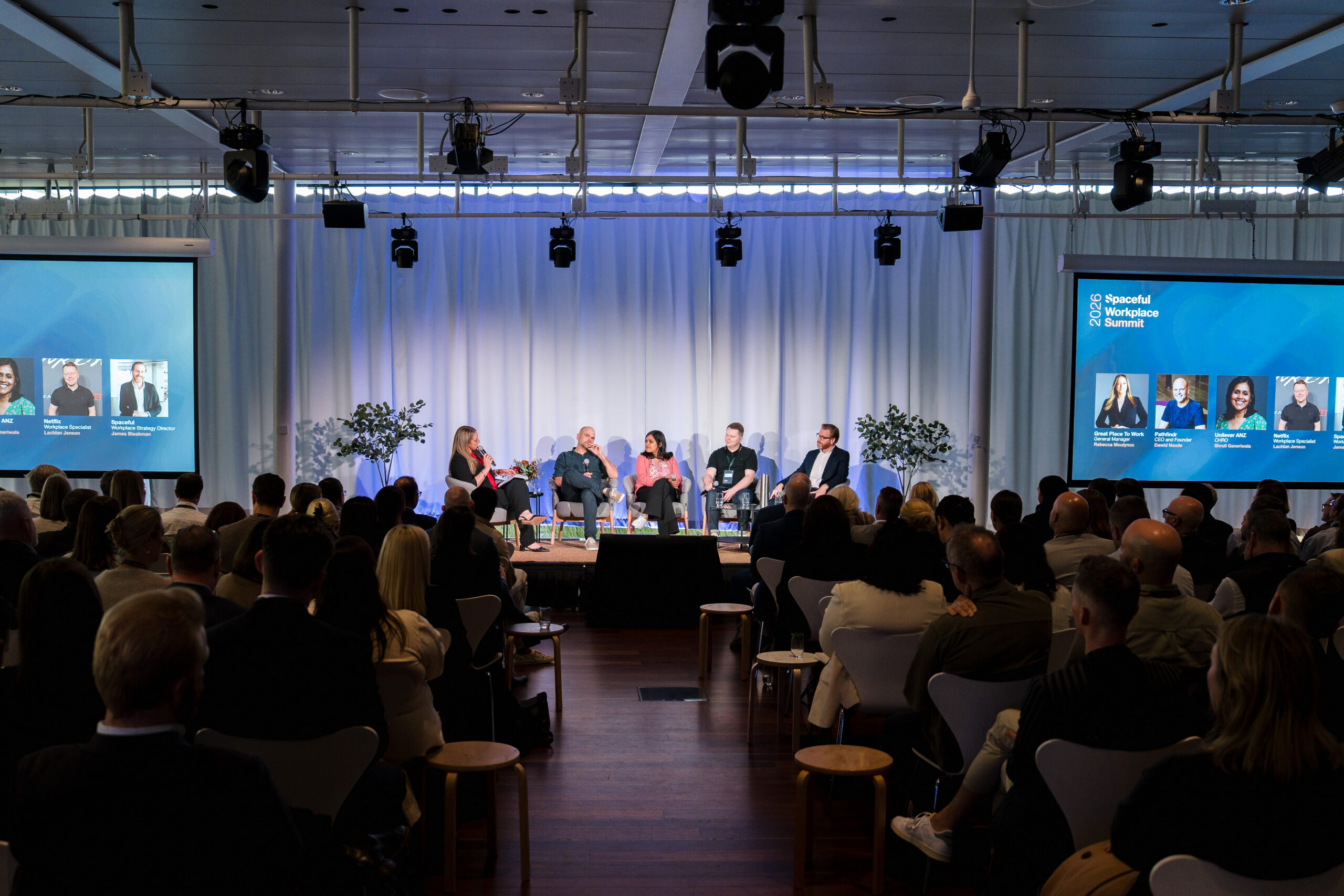
Key takeaways from the Spaceful Workplace Summit 2026
The discussion highlighted four major shifts shaping workplace strategy:
- Performance and employee care need to be treated as connected priorities.
- Offices need to offer clear value if people are expected to use them.
- AI should be embedded into business strategy, rather than managed as a separate initiative.
- Workplace investment needs stronger data to help leaders measure impact and make confident decisions.
Across discussions with Mark Bouris and leaders from Unilever, Netflix, Pathfindr and Spaceful, speakers explored how AI, economic pressure and changing employee expectations are reshaping the role of the office. The consensus was that the workplace can no longer be treated as a default setting for work, it needs to support performance, connection, capability and choice.
Performance and care are no longer separate conversations
One of the clearest themes to emerge was that performance and employee care need to be treated as part of the same agenda, not competing priorities. Shruti Ganeriwala, CHRO at Unilever ANZ, said organisations need to move beyond the traditional assumption that accountability sits at one end of the spectrum and care at the other.
“Performance is care,” said Ganeriwala. “Traditionally, most organisations think about care and employee wellbeing at one end of the spectrum, and performance and accountability at the other end. The narrative we are changing in our business is performance culture.”
She said that shift requires stronger leadership capability, more deliberate support for managers and a continued focus on helping leaders navigate ambiguity while maintaining accountability.
What value does the office need to offer now?
The panel also made clear that the office still matters, but its role has changed. James Bleakman, Workplace Strategy Director at Spaceful, said hybrid work is now established, which means businesses need to think more carefully about the value of physically being in the workplace.
“There needs to be a reason for people to travel into the office,” said Bleakman. “Making it a high-value space for people to actually be in once they’re there, they’re the kind of businesses that are changing that whole narrative of mandate to choice.”
Bleakman added that many businesses are now looking for workplaces that better support focus, mentoring, growth and higher-value interactions, rather than relying on the office as a default setting for all work. That view was echoed by Ganeriwala, who said Unilever has focused on creating more intentional in-person moments through aligned team days, learning opportunities and better connection between colleagues.
Lachlan Jenson, Workplace Specialist at Netflix, said the more useful question for organisations now is not simply where people work, but how they do their best work.
“We’re starting to see companies leaning into giving people choice,” said Jenson. “The autonomy and trust that requires is really encouraging.”
He said strong workplace performance comes from close alignment between business priorities, employee needs and workplace design, backed by active listening and a willingness to evolve the experience over time.
How should leaders approach AI in workplace strategy
AI was another major focus of the panel, with discussion moving beyond experimentation and towards how leaders can build real organisational capability. Dawid Naude, Founder and CEO of Pathfindr, said many businesses are still approaching AI in the wrong way by handing it off to a single function or treating it as a side initiative.
“There shouldn’t be an AI strategy,” said Naude. “AI is an input into a business strategy.”
Naude said leaders need to become active users themselves if they want to drive meaningful adoption, and argued that AI should be used to improve decision-making and unlock new ways of working, not just automate routine tasks. He also pointed to the importance of creating a culture where teams share how they are using AI in practice, rather than leaving it as an individual tool used in isolation.
How can leaders build confidence in workplace investment?
Panellists also highlighted the need for offices to become more flexible, more measurable and more closely aligned to how work is actually happening. Bleakman said many organisations are still hesitant to act because of uncertainty around utilisation and quantifying the value of a workplace fit-out.
“One of the factors that we find is the lack of data to give leaders confidence to actually move forward with the transformation and being able to also quantify that return on investment.”
He said stronger workplace data is helping build confidence around major decisions, adding that Spaceful has developed the Impact Index, a tool to help measure the impact of a workplace fit-out across people, culture, place and technology, giving clients a clearer way to assess outcomes and build the case for investment.
The panel concluded that the future workplace will need to do more than support attendance. It will need to support performance, connection, capability and change, while remaining flexible enough to evolve alongside new technologiesand new ways of working.