
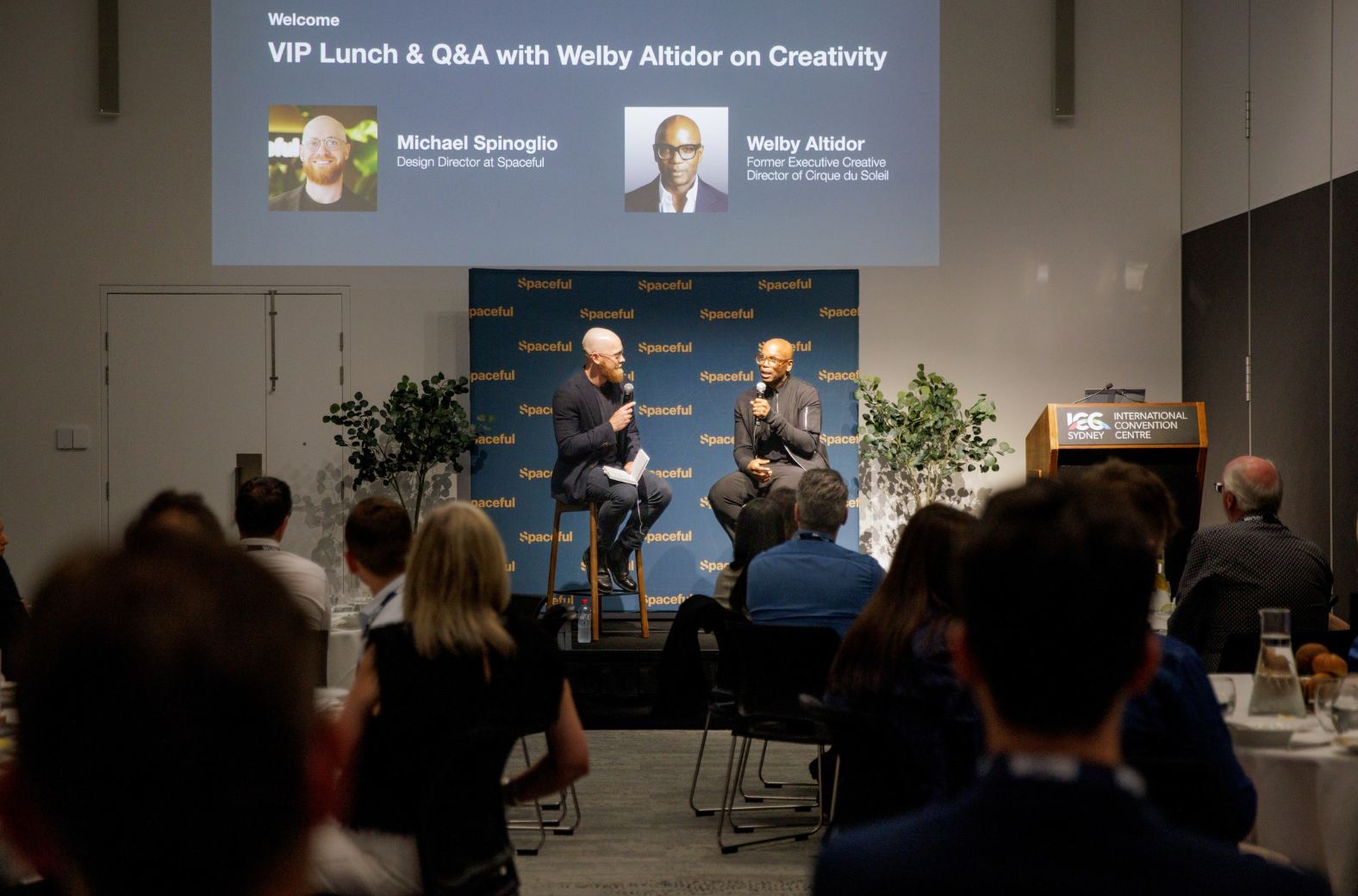
At the World Business Forum Sydney, Spaceful Design Director Michael Spinoglio sat down with Welby Altidor, former Executive Creative Director of Cirque du Soleil and author of Creative Courage.
Their conversation focused on a challenge familiar to many leaders: how to take an ambitious idea, test it, protect what matters and turn it into an experience that works in the real world.
The key lesson was simple: strong ideas start with meaning, stay relevant to the people they serve and are clear enough to survive the realities of delivery.
Why meaning matters more than novelty
One of Welby’s clearest points was that relevance matters more than novelty.
New ideas, technology and design features can create excitement, but that fades quickly if they are not grounded in what people actually need.
“There’s always this tension between novelty and relevance. To me, relevance eats novelty for breakfast. We love new things, but novelty can be a trap. I always come back to meaning and purpose, and ask what we want people to feel and whether what we’re creating is relevant to them.” – Welby Altidor
For workplace leaders, that means starting with the purpose of the workplace before deciding what goes into it. How do people need to work? What behaviours should the space support? What experience should employees and clients have?
The solution comes after those questions.
How do you protect a strong idea through delivery?
Welby compared the creative process to a spacecraft re-entering the atmosphere.
An idea eventually has to withstand budgets, business objectives, stakeholder opinions and practical constraints. If the original idea is too safe or weak, it can disappear under that pressure. A stronger idea can be refined by it.
“You have a strong concept, but eventually it has to re-enter the atmosphere. That’s where you encounter objections, spreadsheets and business objectives. If the idea is ambitious and strong enough, those pressures don’t destroy it. They help clarify what is actually important.”
The lesson is not to protect every detail.
Leaders need to understand what is fundamental to the idea, what can change and what cannot. That clarity makes it easier to make trade-offs without losing the original intent.
Keep coming back to the people you are designing for
Welby also spoke about the danger of falling in love with a concept and losing sight of who it is meant to serve. The same applies to workplaces.
A design can look impressive and still fail if it does not support the people using it.
Research and planning can reduce that risk, but the real test comes once people start using the space.
That is why workplaces need enough flexibility to respond as work patterns, technology and business needs change.
Meaning matters more than spectacle
When asked what separates a memorable experience from one that is simply impressive, Welby’s answer came back to meaning. Spectacle can attract attention, but it does not necessarily create a lasting connection. Meaning comes from understanding the audience, the context and the story behind the experience.
For workplaces, opening-day excitement is not the measure of success.
The better test comes months later. Are people still using the space well? Does it support focus, collaboration and connection? Does it help the organisation deliver the experience and culture it set out to create?
What role will physical workplaces play in an AI world?
As digital experiences become easier to create and harder to verify, physical workplaces have an opportunity to offer something increasingly valuable: real presence, shared experience and human connection.
Welby’s view was not that physical and digital experiences should compete. Instead, he sees growing opportunity in the space between them, where technology can add to a physical experience rather than replace it.
“I don’t really think about physical and digital space as completely separate anymore. There’s an opportunity where our physical reality and digital reality come together. The important thing is that technology is serving us, rather than us serving the technology.” – Welby Altidor
For workplace leaders, the question is no longer whether people can work digitally. It is what is gained by bringing people together in person, and how the workplace can make that time worthwhile.
The leadership lesson
The discussion may have started with creativity, but the principles apply much more broadly.
Leaders regularly have to back ideas before the outcome is certain, bring others with them, navigate constraints and decide what matters enough to protect.
The strongest ideas are not simply the newest or most impressive. They are the ones that remain relevant to the people they are designed for and still hold together when they meet the realities of delivery.
Thinking about what this means for your workplace?
Explore our latest research into workplace experience, attendance and the role of the office in supporting people, culture and performance.